
A life along the coast
Interview with Sue Woodward, October 6TH, 2025
There were seven of us, lots of cousins. We did lots of fishing. We’d set a net, catch bream, mullet, trumpeter, flathead, cod (yuck). And we’d take the boat out and fish for flathead and perch. There was always seagrass here. My kids would complain about the “weedy water”. I think it used to move around a bit.
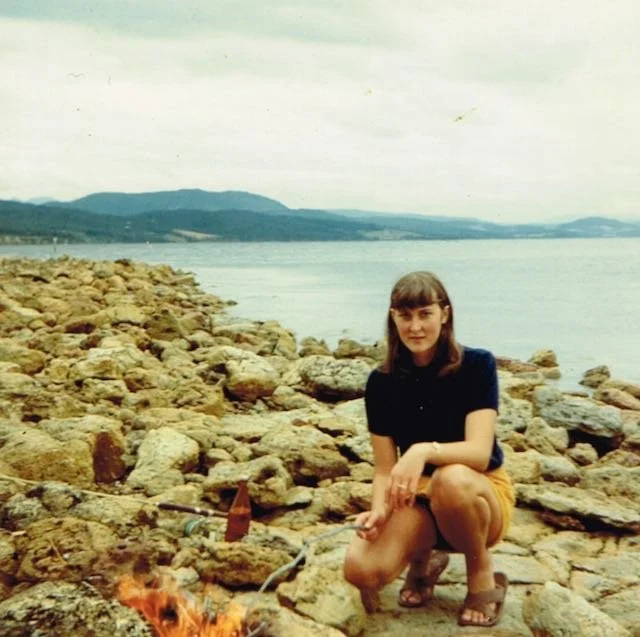
Sue on the point at Eggs and Bacon Bay (1970)
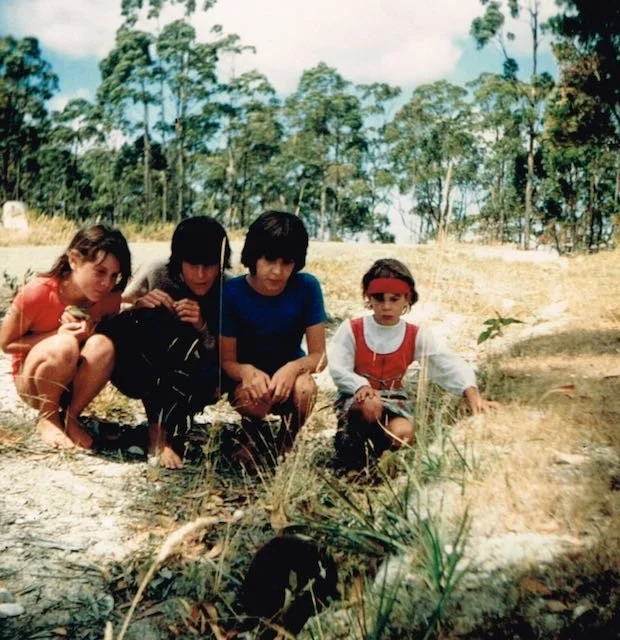
The Woodward children and a cousin observing an echidna in the grass (early 1980s)
I was born in 1948 and grew up in Cradoc. My parents worked in the apple industry. We moved to Hobart when the apple season closed around here. Dad worked at K and D [hardware] in Hobart.
I moved to the mainland and became a nurse. I lived in WA where I met my husband, Ron, and eventually moved back to Hobart.
Our family had a block of land, then a shack on Crown land at Eggs and Bacon so, as children, we camped and then spent time at the shack. Dad gave us one of his blocks at Eggs and Bacon so we could build a shack. We sold it when we retired and moved down here in 2002 and built this place.
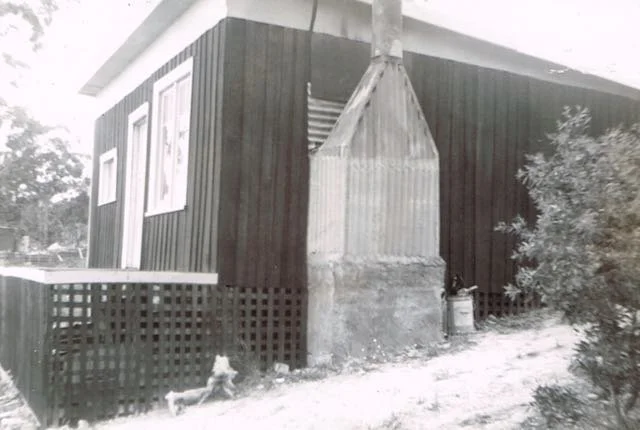
The Woodward shack c. 1970
It was all bush. The roads that we see now were just sandy or clay tracks (Flakemores was just a sandy track, then we’d shoot up the hill – fast, if it was wet, as it was clay). You could walk to Mickeys or Randalls [bays], down the sandy track, swim and then return home.
There were seven of us, lots of cousins. Lorraine Dillon’s parents (Betty and Charlie Thorpe) ran the RSL and there’d be a big picnic. There was a lot more sand then. It was thicker and softer.
We did lots of fishing. We’d set a net, catch bream, mullet, trumpeter, flathead, cod (yuck). And we’d take the boat out and fish for flathead and perch. We always had a boat. We’d take the grandkids fishing and always catch flathead.
I used to dive for abalone, we’d also take scallops, native oysters, mussels. There was always plenty of seafood.
There was always seagrass here. My kids would complain about the “weedy water”. I think it used to move around a bit. And there was fairly good kelp around here still. Something I noticed was that there used to be piles of it on the shore [15 years ago or more], like it was washed up, dead. I haven’t been swimming in it lately, so I can’t say what it’s like now. The grandkids still complain about the weed!
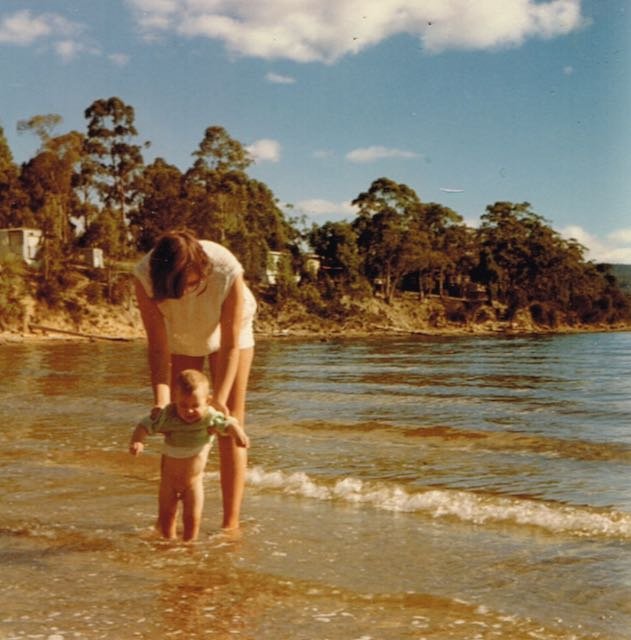
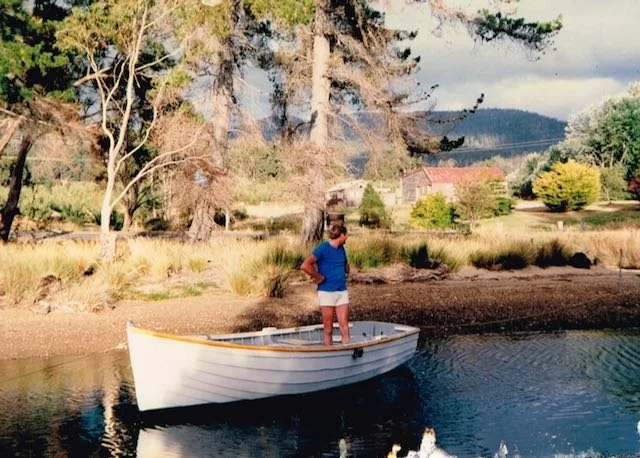
Sue with son Paul (1972)
We’ve seen three phases since we’ve been here:
1. Used to get fibre from the paper mill getting caught in the nets.
2. The river came back when that closed down.
3. Then the muck from the salmon farms came.
In the early days of the salmon farms, they had smaller boats tearing around and losing stuff overboard. We used to find a lot of debris, big coils of rope. Since the overseas company has operated the farm, they use bigger boats and we don’t see the amount of rubbish any more.
It didn’t used to worry us when the salmon farms started, but when the “mess” started, it was serious.
We noticed as the farms got bigger (16-17 years ago?) that there was a lot of sediment settling on the abalone and the grasses. We had to brush it off. I guess it was from the fish food and their waste.
I got involved with Coastcare with Jan [Perigo], in the 1990s. My kids knew her kids. Jan and Rob were really the one who started it all; they always cared about the coast.
I didn’t really know a lot about weeds and things back then, like Spanish heath. I started on weeds, before getting involved in planting. Sandrock Bay was my biggest project with Jan, and Lester [Spinaze] and Colleen [Macmichael], building the track and then doing the planting. Lorraine and I just plodded along, did what we could.
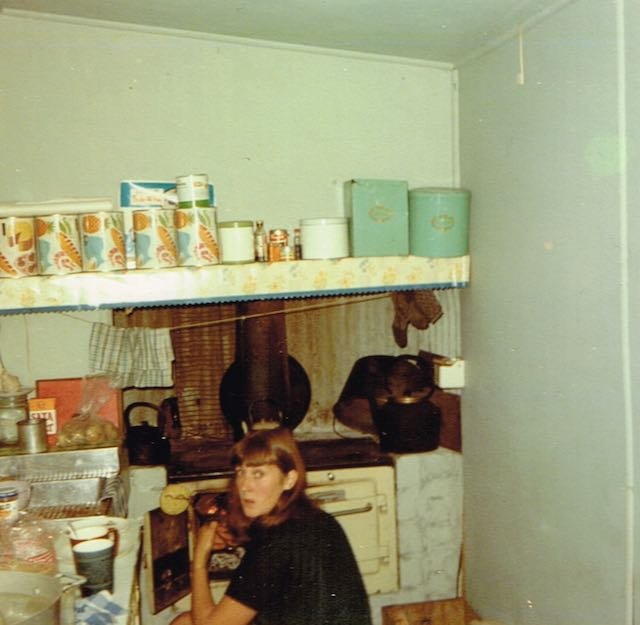
Sue in her kitchen at the shack (1970)
Deep Creek to Stink Beach
Stories from Malcolm Merchant while walking from Deep Creek to Stink Beach, April 14th, 2025
There were never meadows of seagrass right here, but when the tide goes right out, on the mudflats to the southwest of the bay, near the drop off, you’ll see the seagrass bed there [near Elizabeth Point].
About me
I was born in 1951. I’m a twin with Margaret, and we’re the youngest of three boys and two girls. We lived on the corner of Abel’s Bay Road and Channel Highway. When nana and pop died, dad renovated the [yellow] house over there. Then, when Julie and I got married, we bought the schoolhouse up on the hill for $10,000. The school had closed around 1936.
My brother, Bruce, married Zelda Wolfe and built the house near the fire station. Geoff and Josie built the Deep Bay Community Hall. It was moved to Gordon and burnt down in the 1967 fires. My other brother, Stewart, passed away two years ago.
My great-grandfather was a convict sent to Norfolk Island and then Port Arthur. After he was granted leave, he settled at Randall’s Bay. This became Merchant’s Hill; they owned a lot of property. My grandfather, Walter Merchant (married Margaret Thorpe), was one of 14 children. I was about four or five when he died. His half-brother Eric had a freighting service and could get anything in WW2 when you couldn’t buy anything! He sold the property to Max Wolfe, Zelda’s brother. Dad had land around Deep Bay, in Skyfarm Road - orchards and dairying.
This part was known as the Bottom Paddock, where pop kept his draught horses. They were completely self-sufficient. There were stables for the horses, they milked cows, they had the honey house and a smokehouse for when they killed a pig. They had fish and a veggie garden; the dam is still up there.
Opposite Skyfarm Road used to be an old orchard, and there was a dam that’s only been filled in a few years ago.
I’ve had more jobs than you could dream of. I started off in the family orchard and milking cows, then went to Mackay, working in the sugar cane and carting cane to the railway.
I have three daughters – a paramedic in Canberra, an aged carer at Franklin, an aged care worker in Snug.
Recollections of the coast
I spent every weekend in my dinghy, messing around. There were always scallops here - Dad used to row the boat and I’d hang onto the scallop dredge. It was a nice place to grow up. There were only a couple of other kids in Deep Bay my age and after a while they moved away to Hobart. Once a whale washed up on the mud flats. Dad towed it out to Huon Island. He said, if we don’t get rid of it, we’ll never live in Deep Bay when it starts to decay and falls into pieces.
Deep Bay’s as good as ever… that’s why I brought my caravan here. There’s always cuttle fish here, and tons of petrified wood, and some fossils. And there’s also a cod bed out from the point.
The creek [Deep Creek] has definitely changed. This was all sand [western shore], and now it’s mudflats. The Cygnet Tennis Club used to come out once a year to get sand from this bank near the bridge to top up the courts.
This is the remains of the old bridge. The new bridge and highway alignment happened in 1962. Dad sold off some of his land. The road used to go across in front of what is now ‘Ingledale’, then there was a sharp bend after the bridge and then across in front of the first house on Abel’s Bay Rd.
Dad used to bring a 23’ motor boat up this creek, on the low tide even. There’s one of the original pegs on the other side of the creek that he used to tie up his boat to hold it. The coming and going of the boat, the propellor, probably kept the channel open. Once dad sold the boat, that didn’t happen anymore!
There was a little island here (see this pointy bit?) and an old goose would lay eggs there every year. This is all fill from when they dug out for the road. It’s eroding but it’s just trying to get back to what it was. It’s just loose stuff that hasn’t had time to settle. That big rock has been there as long as I can remember.
All this rock here used to be sand. This bank has definitely gone back over a period of 40 years. It used to extend out a long way [now shale and stones with pigface growing]. The flat “flowing” rocks have always been here, the tessellations. And the copper in the different layers in the bank’s profile was always there and you can see it further around towards Stink Beach.
The oysters have come from the former oyster farm at Gardner’s Bay. There were never ever oysters here when I was a child.
Stinking Creek doesn’t have any flow in the summertime. There’s a spring there and an old pump house. Old Mr Thomas used to pump water up to his house. There’s another seam of copper here. You can see those trees that have fallen in because of erosion.
There were never meadows of seagrass right here, but, when the tide goes right out, on the mudflats to the southwest of the bay, near the drop off, you’ll see the seagrass bed there [near Elizabeth Point].
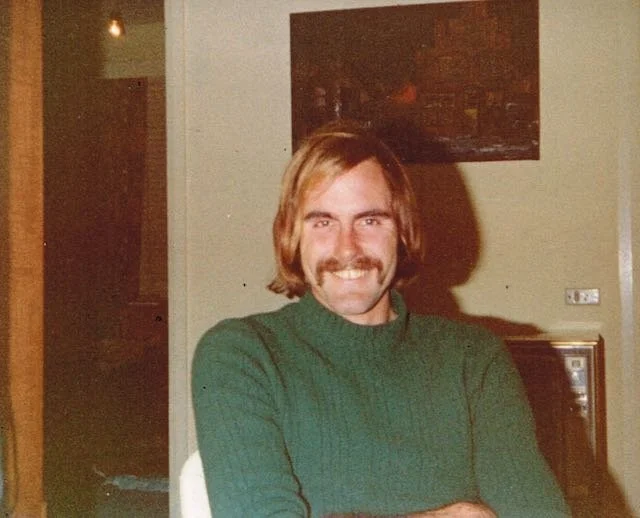
Young Malcolm Merchant